
With over twelve years in web development, design, and technical management — alongside years inside a digital marketing agency — I've watched the same problem recur. A core DM responsibility like conversion tracking gets quietly offloaded onto the website developer. It isn't the web developer's responsibility or skillset. It isn't even the same industry.
It's only become more frequent, so here's a clearer expectation for anyone investing in digital marketing services.
In short: what clients should expect
If you hire a DM agency to manage campaigns like Google Ads or to manage other growth metrics and outcomes, they should be fully capable of implementing the tracking infrastructure required to measure those services. It's a major part of their industry's skillset. Expecting your web developer to do it instead is misguided — it duplicates costs and points to a skills gap in the agency's offering.
The core problem
Many DMs sell services they can't — or won't — fully implement. If you're running a Google Ads campaign, the agency needs accurate analytics to measure success. Those metrics directly inform decision-making and strategy. If the agency can't implement and manage the tracking infrastructure that enables this analysis, they're not fulfilling a core part of the role. The data is an inherently vital component of digital marketing.
Tracking setup is a marketing-domain task
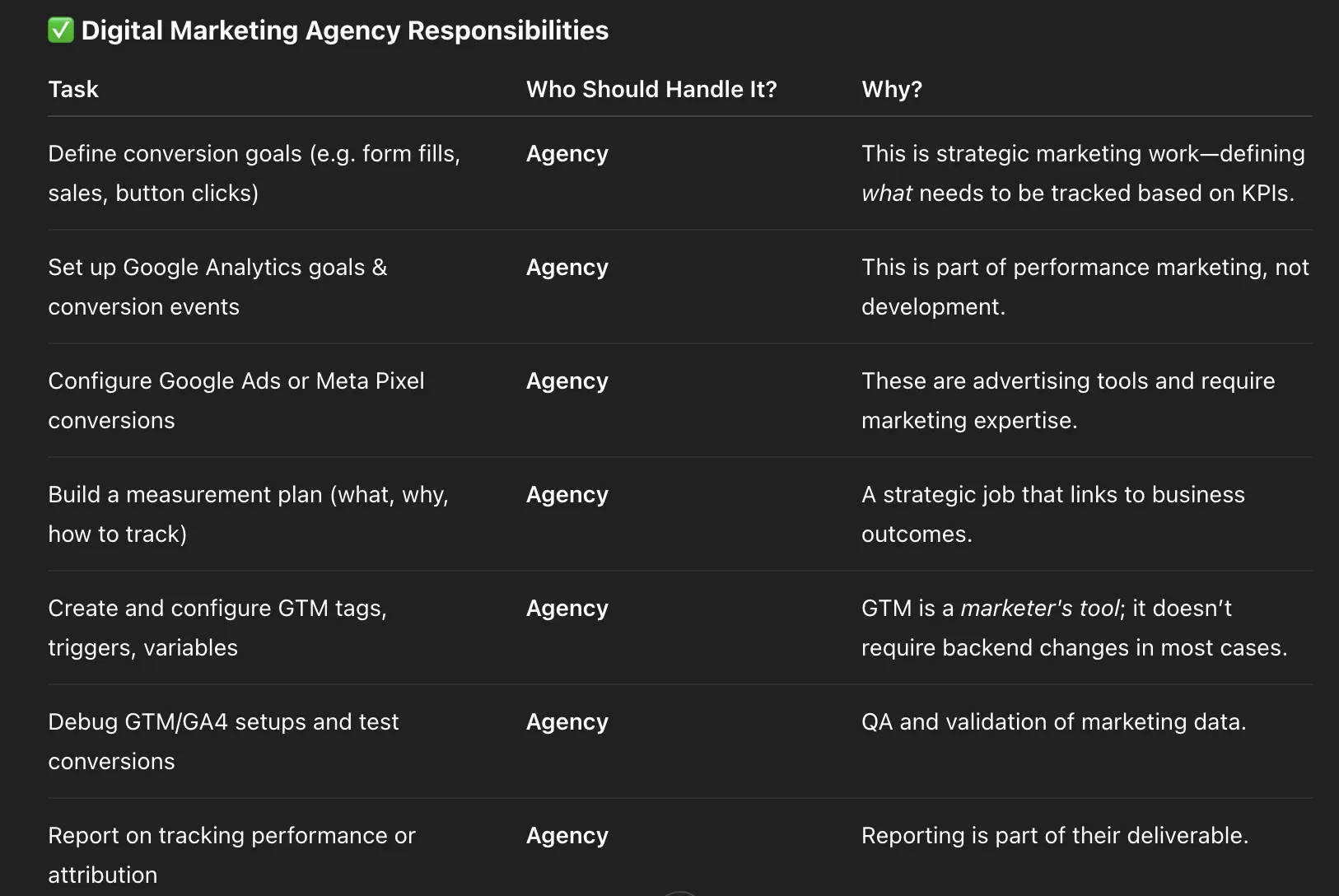
One of the clearest signs of a competency gap is when a DM asks the web developer to set up tracking. This isn't a web development responsibility — it falls squarely within the DM domain. Proper implementation and ongoing management of tracking is a key marketing skill. And on a practical note, only the DM team will know the micro and macro tracking specifics that the campaign actually needs.
The standard tool is Google Tag Manager (GTM). GTM lets marketers configure and manage tracking scripts independently of the website codebase. It's purpose-built for this, and it's the best-practice method. If your marketing provider isn't using GTM or a comparable system, it raises serious questions about how they're managing your campaign data.
A digital marketing agency is not doing their job if their skillset doesn't include understanding marketing data and knowing what to do with it. And they are not doing their job if they don't know how to implement and manage the tracking scripts that collect that data. These two things are fundamentally the job.
The website developer's role is minimal
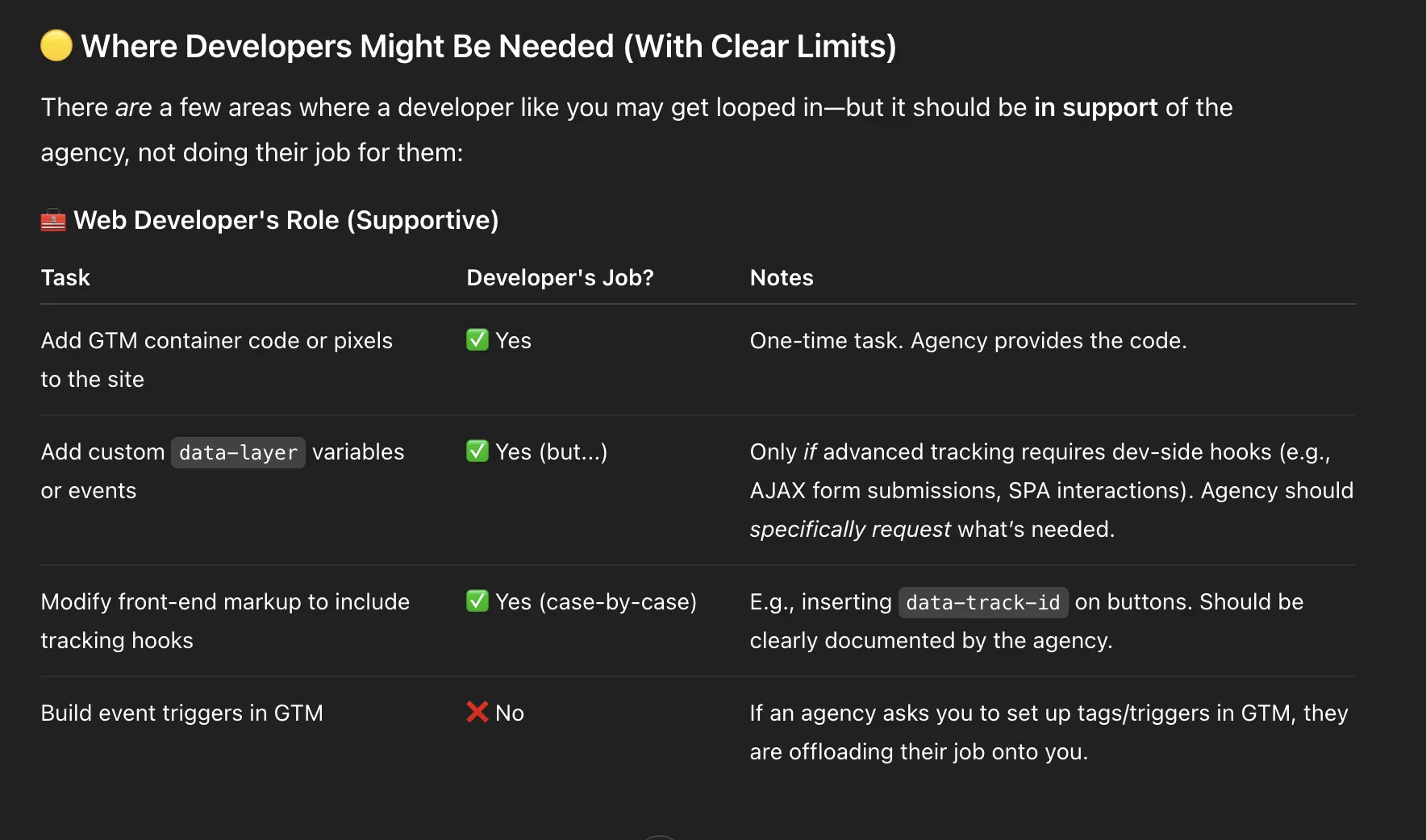
The only involvement a web developer should have is adding two GTM snippets to the site — one in the header, one in the body. The DM provides them. That connects GTM to the website, and that's it. The website is not where tracking script management happens, for many good reasons.
What ChatGPT says
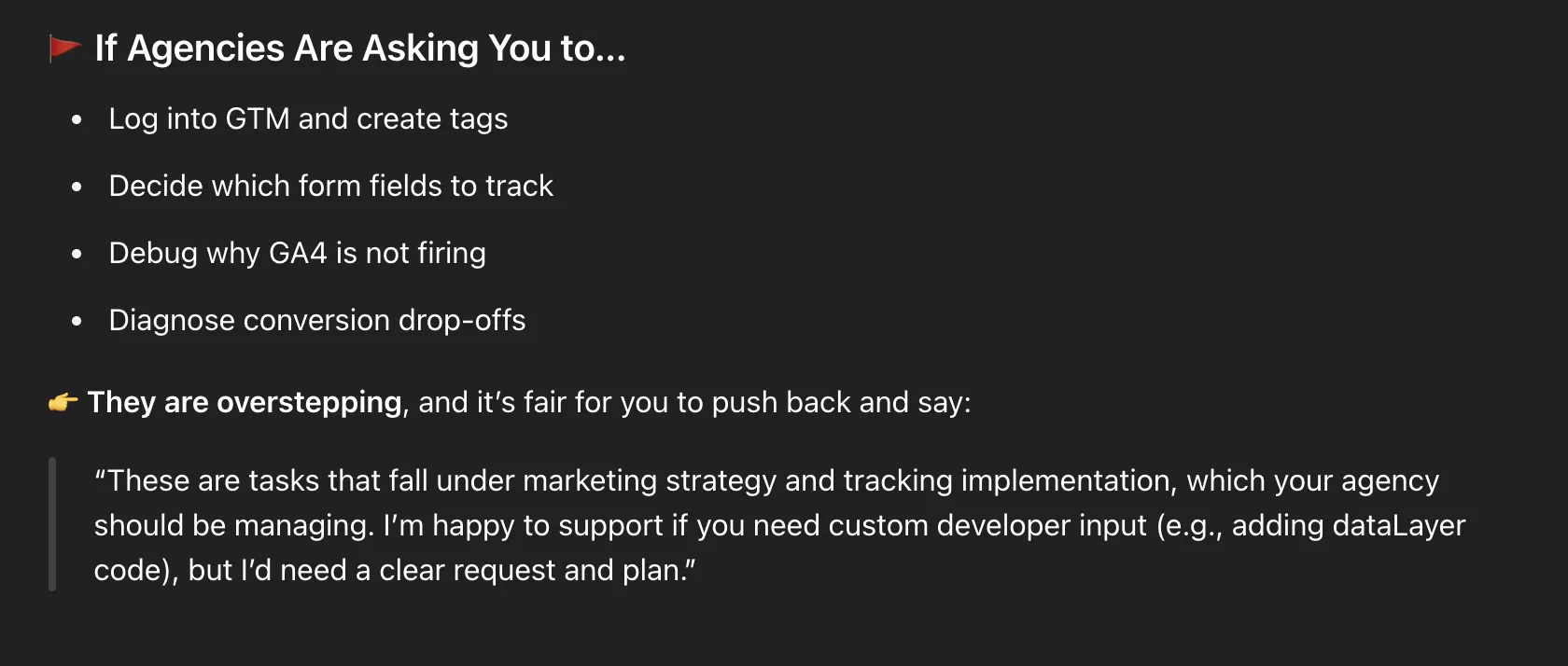
If you're not sure what's reasonable to ask of each party, here's the same breakdown an AI model lands on when asked the same question.
A growing concern
I increasingly meet DMs asking me — the web developer — to configure their campaign tracking. The trend likely reflects a rise in underqualified services. When clients pay for digital marketing, the expectation is complete delivery, including data tracking setup — not a handoff to an unrelated third party. Official documentation that suggests involving a "developer" refers to a technical expert within the DM team, not your external website developer. These are separate domains.
A reasonable exception
A one-time script addition for a simple campaign — say, a client manually setting up a single Facebook event without a full-scale marketing effort — is fine. But if a professional agency is involved, they should provide the GTM code, and the web developer's only task should be adding those two snippets. Everything else stays in the agency's scope.
Questions to assess a DM's competency
- I understand that the digital marketing services we discussed would require setting up tracking scripts in Google Tag Manager. Are you skilled in configuring and building conversion tracking and related scripts in GTM?
- If you don't use GTM to build and manage tracking scripts — what do you use?
- Are you skilled in administering and configuring Google Ads thoroughly, using modern best practices?
- Do you hold a Google Ads Certification, or a Google Digital Marketing & E-commerce Certificate?
- If you don't have certifications, I still expect the skillsets and deliverables outlined in those certifications to be part of your service. Agreed?
- Is your team competent at understanding feedback data from Google Ads and other campaigns, and adjusting accordingly to hone in on what works?
- Can you share success stories? What key interpretations from analytics drove that success?